Proposal Submission Deadline Policy
The University of Michigan proposal review deadline policy sets deadlines for the review of external funding proposals. Learn more about this policy and working with the Office of Research and Sponsored Projects.
To help sustain its position as a leading public U.S. university in research expenditures, the University of Michigan has a proposal review deadline policy for the submission of external funding proposals. This policy establishes explicit, fair and uniformly applied levels of service for processing proposals. It was developed in coordination with research administrators, faculty, deans and other U-M leaders.
Many schools and colleges have implemented their own policies to align with this U-M policy.
Levels of review
A proposal for external funding will receive one of two levels of review — full or limited — depending on when the final version of the proposal and its accompanying finalized proposal approval form (PAF) are received in the Office of Research and Sponsored Projects (ORSP).
Full review
A Full Review is the level of service that ORSP provides when the final proposal and approved PAF are received 32 or more business hours prior to the Submission Deadline on the PAF. In Full Review, the final proposal and approved PAF are checked to ensure compliance with both U-M’s and the sponsor’s requirements. Any known terms and conditions of the sponsor that would be binding upon the issuance of a resulting award will also be reviewed for acceptability under U-M policy prior to proposal submission.
ORSP may request Required and/or Recommended Changes. Required Changes relate to compliance with U-M policies or other U-M requirements and must be made in order for ORSP to submit by the sponsor’s deadline. Recommended Changes are offered to make the proposal compliance with a sponsor requirement and optional, though considered to be best practice. Provided that any such changes are returned by the principal investigator (PI)/project team to ORSP in a timely fashion, ORSP will ensure the final proposal is submitted by the Submission Deadline and successfully received by the sponsor.
Limited (institutional only) review
In a Limited (Institutional Only) Review, ORSP only ensures compliance with U-M policies or other U-M requirements but does not check for compliance with the sponsor’s guidelines. A Limited Review is the level of service provided for proposals submitted to ORSP with a lead time of fewer than 32 business hours but at least 15 business hours prior to the submission deadline (e.g., no later than 9 a.m. one business day before the sponsor’s deadline).
Proposals that qualify for a Limited Review will be submitted by the Submission Deadline entered on the PAF, provided that any Required Changes identified by ORSP are returned by the PI/Project Team to ORSP in a timely fashion and ORSP staff have prior experience with the sponsor’s electronic proposal submission system (if applicable).
ORSP cannot guarantee that a proposal receiving a Limited Review will be complete or correct when submitted, nor that ORSP could accept the terms of an award on behalf of U-M. ORSP is not responsible for the potential negative outcomes of a proposal that only receives a Limited Review, such as: 1) submitting with fatal errors that prevent receipt by the sponsor, 2) failing to comply with the sponsor’s requirements, 3) receiving an “administrative turndown” from the sponsor on technical grounds, and 4) receiving a resulting award that U-M cannot accept because it contains non-negotiable terms and conditions that are inconsistent with the University’s requirements.
Proposals at risk
Proposals that arrive at ORSP fewer than 15 business hours prior to the submission deadline will be assigned “at risk” status. ORSP cannot guarantee “At Risk” proposals will be submitted by the sponsor’s deadline or will be complete or correct upon submission. The proposal must first receive a Limited (Institution Only) Review before it may be submitted, and ORSP gives priority to the proposals in the queue that have met U-M’s internal deadline for Full and Limited Reviews.
ORSP is not responsible for the potential negative outcomes of an At Risk proposal, such as: 1) missing the sponsor’s deadline, 2) submitting with fatal errors that prevent receipt by the sponsor, 3) failing to comply with the sponsor’s requirements, 4) receiving an “administrative turndown” from the sponsor on technical grounds, and 5) receiving a resulting award that U-M cannot accept because it contains non-negotiable terms and conditions that are inconsistent with the University’s requirements.
Deadline policy calendar examples with levels of review
Here are some calendar examples to help plan. Click the image to view more.
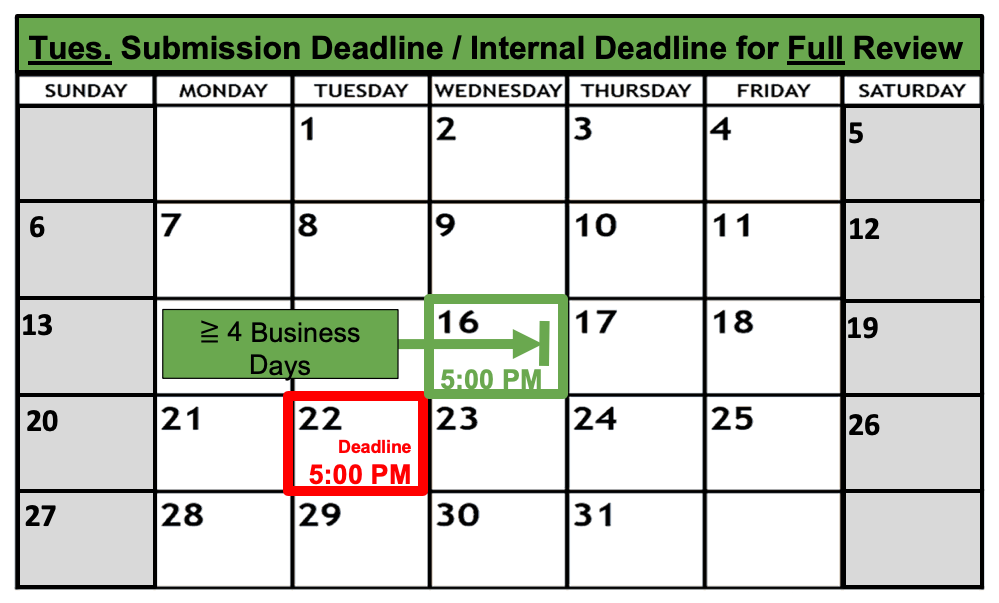


Summary of service levels
| Business hours prior to submission deadline that final proposal and finalized PAF are received in ORSP | |||
|---|---|---|---|
| Service level standard | Review Levels | ||
| Full Review* ≥ 32 business hours | Limited (Institutional Only) Review** < 32 to 15 business hours | At Risk <15 business hours |
|
| Proposal checked for compliance with U-M requirements | X | X | X |
| Proposal submitted by submission deadline | X | X | |
| Proposal checked for compliance with sponsor guidelines *** | X | ||
| Terms & conditions binding upon award reviewed for acceptability | X | ||
| Proposal successfully received by sponsor | X | ||
* Full Review: ≥ 4 business days
** Limited (Institutional Only) Review: < 32 to 15 Business hours (i.e., no later than 9 a.m. one business day before the submission deadline)
*** Formatting is not reviewed by ORSP.
Deadline definitions
Final proposal: A proposal that is ready for ORSP or the PI/Project Team (when applicable) to submit at any time. The PI/Project Team considers the proposal to be finished and will not make any further changes. ORSP may need to provide additional documentation or signatures to submit the proposal, but everything else is in final form and is “submission-ready.”
Incomplete: An Incomplete proposal is one that is not Final or “submission-ready” in some significant way, such as a required component missing or a temporary placeholder in lieu of a final document. The PAF for an Incomplete proposal will be returned to the PI/Project Team, an action that removes the review assignment (Full, Limited, At-Risk) and “resets the clock” – meaning the level of review will be recalculated when the proposal is “re-finalized.” Proposals will also be returned as Incomplete if 1) the PI/Project Team requests that ORSP return it for further editing (the proposal was then, by definition not Final), or 2) ORSP is responsible for submitting the proposal and has not been granted access to the sponsor’s online submission system.
ORSP Review – Project Team Making Changes: The state of a PAF any time it is returned by ORSP to the PI/Project team to make changes, regardless of whether the changes are Required or Recommended or because the proposal is Incomplete.
Recommended change: One of two types of changes that ORSP may identify. They are offered whenever ORSP’s review of the Final Proposal reveals certain edits that would improve compliance with the sponsor’s guidelines. They are optional and made at PI/Project Team’s discretion.
Required change: One of two types of change that ORSP may identify. A “Required Change” indicates when something on either the PAF or the Final Proposal must be fixed in order to be compliant with U-M policies or requirements. Required changes must be made prior to proposal submission.
Submission deadline: The date by which a proposal must be submitted to the sponsor in order to be received by the sponsor’s deadline and avoid being disqualified for consideration of funding. (In the case of electronic proposal submissions, the Submission Deadline is the same day as the sponsor’s published deadline date.)
- U-M’s proposal submission deadline policy applies whenever a Submission Deadline is entered on the PAF.
- The amount of lead time between the Submission Deadline and ORSP’s initial receipt of both the Final Proposal and approved PAF determines the level of service ORSP will provide.
Target date: The date by which the PI/Project Team desires ORSP to complete its work on the PAF (e.g., submitting a proposal for external funding and/or concluding the negotiation of a contract/funding agreement). Entering a Target Date is optional, considered a preference, and can be provided in conjunction with a “Submission Deadline” or on its own.
Timely fashion / completion of changes: A relative term for how far in advance of the Submission Deadline the PI/Project Team returns a PAF to ORSP with any Required or Recommended Changes.
As a best practice ORSP recommends changes should be returned to ORSP with sufficient time for ORSP to complete the final review, approval, and if needed, submission. Circumstances may dictate shorter or longer turnaround times.
Download the ORSP PAF and Proposal Checklist
Use this checklist as a reference for what ORSP reviews for Full and Limited Reviews.
Deadline policy: PAF and proposal checklist
Full Review
When a finalized PAF and final proposal are received in ORSP 32 business hours or more prior to the Submission Deadline, ORSP will check all of the items listed below as part of a Full Review, and will work with the Project Team to resolve any issues prior to submission. Proposals receiving a Full Review will be compliant with the sponsor’s guidelines and will be submitted by the Submission Deadline.
Limited Review
If a finalized PAF and final proposal are received in ORSP less than 32 business hours prior to the Submission Deadline, ORSP will only check the PAF and proposal for compliance with U-M’s requirements. The proposal will be submitted by the Submission Deadline. However, there is no guarantee that a proposal receiving a Limited Review will comply with the sponsor’s guidelines or that U-M will be able to accept any resulting award.
Sponsor system access and relationship management
- If applicable, sponsor system access to submit proposal provided to ORSP. (NOTE: Return as Incomplete)
- When Project Team submits proposal via sponsor’s online system, the proposal information provided by Project Team matches information provided in the PAF.
- When ORSP submits proposal via sponsor’s online system, the proposal information in sponsor’s system matches information provided in the PAF.
- If sponsor is a Managed Entity, appropriate U-M office (e.g., Development, Business Engagement Center) is contacted prior to submission.
Deadline information
- Submission Deadline on PAF is correct or is left blank when no deadline exists. (NOTE: Return as Incomplete)
Limited submission status
- Whenever sponsor limits number of submissions, OVPR or Medical School Office of Research selection uploaded to PAF.
Administrative Data Congruence and Correctness
- Administrative data in proposal complete and correct (e.g., EIN, DUNS, FWA, etc.).
- Sponsor(s) properly identified on PAF, including Sponsor role and contact info.
- Start/end dates on PAF correspond to proposal.
- Key personnel named on PAF correspond to personnel listed in proposal (and vice versa).
- Project Long Title on PAF corresponds to the title of proposal.
- Budget on PAF corresponds to funding requested in proposal.
- Class code on PAF is correct.
- Facilities & Administrative (F&A) cost rate corresponds to F&A cost rate used in proposal.
- F&A cost rate does not exceed rate appropriate to class code.
Prior award identification (ID)
- Relationship to prior Award ID disclosed on PAF is correct.
Funding opportunity announcement
- Funding Opportunity Announcement or equivalent (or URL, when allowed) provided.
Proposal components and document structure
- Required components of proposal included.
- Sponsor’s required file naming conventions followed.
- Limits on number of pages observed.
Budget compliance
- Sponsor’s restrictions and requirements met (e.g. sponsor prohibits equipment purchases or restricts funds to student stipends).
- Cost sharing requirements met.
- U-M Cost Sharing, Non-U-M Cost Sharing and Other U-M Commitments appropriately recognized and documented on PAF.
- Uniform Guidance monitored costs appropriately justified (for Federal funds only).
- Budget items consistent with Uniform Guidance (2 CFR 200) (for Federal funds only).
- F&A cost rate does not exceed rate allowed by sponsor.
Subrecipients
- Subrecipient’s authorized commitment to participate and status of its FCOI policy (when applicable) are uploaded to PAF.
Disclosed related agreements and documents
- Related agreements, both funded and unfunded, do not prohibit proposal submission.
- Use of third-party IP disclosed on PAF does not prohibit submission.
- Use of U-M proprietary technology disclosed on PAF does not prohibit submission.
- Encumbrances to third parties of U-M IP disclosed on PAF also disclosed to sponsor.
Research compliance
- Compliance-related research activities (e.g. animal research, human subjects) are correctly identified in the proposal.
Conflict of interest
- All investigator conflict of interest questions answered on PAF.
Representations and certifications (reps and certs)
- Sponsor’s representations, certifications and other forms acceptable or modified.
Terms & conditions
- Non-negotiable terms binding upon submission reviewed and, whenever possible, exceptions noted or necessary institutional approvals for submission obtained.
Needed prior agreement
- Agreement negotiated prior to submission, when required (e.g., Teaming Agreements).
Approvals
- Signatures/approvals present and correct.
Deadline proposals: Common questions answered
What’s the latest a proposal can go to ORSP for a Full Review?
ORSP requires a Final Proposal no later than 32 business hours before the Submission Deadline.
Schools, colleges, institutes and centers may require additional reviews and lead time. Engage with unit leadership to learn more about their requirements and deadlines.
May an “administrative shell” be submitted for review?
ORSP will return an administrative shell as Incomplete and will not review a proposal until it has been “finalized” in eRPM. However, schools/colleges/institutes/centers may have a policy to allow or require submission of an administrative shell for their review.
The school or college requires a 7-day [or other] deadline. Do these days need to be added on to the U-M ORSP deadline?
Yes. Schools, colleges, institutes and centers may have their own internal policy deadlines to ensure alignment with ORSP’s proposal submission deadline policy. Engage with the school or college’s unit leadership to learn more about their requirements and deadlines.
Is there a deadline calculator for the new policy?
There is no U-M wide deadline policy calculator as school/college/unit deadline requirements vary to align with U-M’s overall policy. Section 6 of the PAF, titled “Submission Information,”will display the times and dates by which the PAF and final proposal must arrive in ORSP in order to qualify for a Full or Limited Review, calculated from the Submission Deadline entered on the PAF.
What does it mean for a proposal to be “final”?
“Final” means ready for ORSP submission at any time (i.e., ORSP could submit to sponsor within 2 minutes or 2 days after it’s routed to ORSP). ORSP may need to provide additional documentation or signatures, but everything else is in its final form.
Why does ORSP sometimes return a PAF as Incomplete and sometimes return a PAF for changes?
When a PAF is returned as Incomplete, that means the proposal is not “submission-ready” or Final in some significant way. For example, it may be missing some required component or the PI/Project Team has not granted ORSP access to the proposal in the sponsor’s electronic system (when ORSP is responsible for submission). In these cases, ORSP will return the PAF for the Project Team to complete its work, an action that strips the assigned review type and “resets the clock” for determining the level of review (Full, Limited or At Risk) the proposal will receive.
When a PAF is returned for Changes, that means the proposal is Final (e.g., all required components are complete) but ORSP has identified for the PI/Project Team some aspect of the proposal that must or should be changed (i.e., a Required or Recommended change). When a PAF is returned as needing Required or Recommended changes, the action does not “reset the clock” for determining which level of review the proposal will receive.
A proposal was submitted two days in advance of a sponsor deadline, but there was a typo in the research strategy. Since the sponsor’s deadline has not yet closed, could it be requested that ORSP (re)submit a corrected version of the proposal?
Yes, but not without risk. The request will not be prioritized over other proposals that have yet to be reviewed. It’s also important to recognize that resubmitting a proposal first requires that the original proposal be withdrawn, or assessed as Incomplete. Depending on the number of unreviewed proposals ahead of the request, resubmission may be delayed so close to the sponsor’s deadline that it would be inadvisable to withdraw an otherwise high-quality proposal on the chance that the resubmission will be successful and on time.
What if a proposal is due to the sponsor on a Friday, but U-M is a subrecipient, and the primary institution needs the proposal earlier?
Use the earlier date as the Submission Deadline.
Will the internal deadline policy apply to a proposal and PAF if the Submission Deadline is not entered?
No. If there is no sponsor deadline, the deadline policy does not apply. If the Submission Deadline field is left blank, and there is a sponsor deadline, ORSP will return it as Incomplete to add the sponsor deadline.
What’s the difference between a Target Date and a Submission Deadline?
The Target Date is the date by which a project team would like ORSP to submit a proposal or negotiate an agreement. It is optional and considered to be a non-binding request that ORSP will attempt to accommodate when reasonable time is given, but ORSP can make no guarantees that it will be able to do so. A Target Date can be provided alone (i.e., there is no Submission Deadline), in combination with a Submission Deadline, or not at all. For example, a team may wish to enter a Target Date for when they would like a contract to be negotiated and there is no sponsor deadline. Another use of a Target Date is when a project team would like their proposal to be submitted earlier than the Submission Deadline, i.e., earlier than is necessary to meet the sponsor’s published deadline.
What’s the difference between the Submission Deadline and the sponsor’s deadline?
The sponsor’s deadline is the date by which the sponsor has stated proposals must be received in order to be considered for funding. The “Submission Deadline” (a.k.a., the “Send By” date) is the last date that a proposal can be submitted in order to be received by the sponsor’s deadline. In the case of an electronic proposal submission, the Submission Deadline and the sponsor’s deadline are the same. In the case of a hardcopy proposal submission to a sponsor where overnight courier service is available, the Submission Deadline is at least one day before the sponsor’s deadline. In the case of a hardcopy proposal submission to a sponsor where courier service may take an extended period of time, the Submission Deadline is at least several days (or more) prior to the sponsor’s deadline.
Why does ORSP sometimes return a PAF with Required Changes and sometimes return a PAF with Recommended Changes? What’s the difference?
Required Changes relate to compliance with U-M policies or other U-M requirements. A proposal will not be submitted until these Required Changes are made. Recommended Changes are offered to make the proposal compliant with a sponsor requirement. Recommended Changes are optional.
ORSP has performed a Full Review, and found a budget item expressly disallowed by the sponsor. The ORSP officer has returned the PAF for Recommended Changes. Why is this just a Recommended Change and not Required Change?
Recommended Changes refer to sponsor requirements, and the item is disallowed by the sponsor. Required Changes refer to U-M institutional requirements. In this case, failure to make the Recommended Change may result in the proposal not being funded, being funded for an amount that is lower than requested, or being fully funded but restricted by U-M to prevent a disallowed cost.
Why should a project team bother making Recommended Changes?
If the PI/Project Team chooses to ignore the Recommended Changes ORSP has identified, the proposal might not comply with the sponsor’s guidelines and could be rejected without review. ORSP recommends changes to help proposals meet sponsor guidelines. ORSP requires changes when they are needed to ensure compliance with U-M institutional requirements.
Why do project teams only ever receive Required Changes from ORSP, and not any Recommended Changes, when a proposal receives a Limited (Institutional Only) Review?
During a Limited Review, ORSP only checks certain items for compliance with institutional policy and other U-M requirements. Any corrections must be made prior to submission and thus fall in the category of Required Changes. The suggested “grantspersonship” changes that would otherwise be caught during a Full Review are not checked during a Limited Review.
What if the sponsor deadline is 5 p.m. in another time zone?
If the sponsor deadline is 5 p.m. in another time zone, convert it to Eastern Time (ET) and plan to meet U-M’s 5 p.m. ET business day cutoff so the proposal reaches the sponsor on time.
- If the sponsor’s deadline is later than 5 p.m. ET, enter the submission due date on the PAF as usual.
- If the sponsor’s deadline is earlier than 5 p.m. ET, add the earlier ET on the PAF under 6.1.2.
Many sponsors often consider the local applicant institution time as the deadline, even if they are in a different time zone.
A PI is preparing to submit a multi-million dollar project. The project team needs to work until the last minute. Will ORSP submit a proposal with fewer than 15 business hours’ notice?
It depends on multiple factors outside ORSP’s control, including how many other proposals are in the queue and staff availability. The proposal will be classified as “At Risk” and it might not be submitted to the sponsor in time. To fairly support all U-M faculty, ORSP will not prioritize “At Risk” proposals over proposals in the queue that have met U-M’s internal deadline.
In handling such a significant proposal, it is critical that project teams mitigate risk at every level, and this includes building in time to adhere to internal and external deadlines.
What if a faculty member submits directly to the sponsor and then routes a PAF after the fact, rather than complying with the internal deadline policy?
The executive director of ORSP, the associate deans for research, and the chief research administrators of the various schools and colleges will inform the faculty who submit “outside the system” that such practices are against U-M policy. Individuals who show a pattern of disregard for the internal deadline policy may be brought to the attention of the vice president for research, who may impose additional administrative measures in consultation with the appropriate associate dean for research.
Will there be exceptions for proposals with short turnaround times?
No. ORSP may still submit a proposal after conducting a Limited (Institutional Only) Review, but there might not be enough time for “At Risk” proposals to ensure they meet the Submission Deadline.
In the case of limited submissions, will U-M allow additional time for the chosen project team/PI to finalize submission?
No. The deadline policy will apply to limited submissions as it does to all proposals. ORSP will endeavor to submit a proposal if it is “At Risk,” but ORSP cannot guarantee that it will be submitted by the Submission Deadline.
How will collaborative proposals with PIs at other institutions be handled when the other institution causes a delay that results in the proposal arriving in ORSP after the 15 business hour deadline?
Proposals arriving in ORSP after the 15 business hour deadline will be “At Risk.” The deadline policy applies the same to collaborative proposals as it does to all proposals. ORSP will endeavor to submit an “At Risk” proposal, as long as there are no timely proposals already in the queue and there is sufficient time to conduct a Limited (Institutional Only) Review.
Will exceptions be made to the 15 business hour deadline for last-minute proposal requests at the end of the sponsor’s fiscal year, when they are trying to unload funds as quickly as possible? Project teams often are asked to submit the proposal immediately.
No, but ORSP will endeavor to submit a proposal if it is “At Risk.” The reality is that there is simply not enough time to guarantee that “At Risk” proposals will be submitted by the Submission Deadline.
Will the system provide a warning as the 15 business hour internal deadline approaches?
Yes. The cross-campus deadline policy working group designed the eRPM workflow to have a number of trigger points in the PAF lifecycle that automatically generate a warning email.
Can ORSP assure that sufficient staff will be available to review, approve and submit proposals during heavy deadline submission dates?
Yes. ORSP is prepared to staff the office as needed during peak volumes to process proposals that meet the internal deadline for Full and Limited Reviews.
Missed deadlines
How will the system handle a proposal that missed the sponsor deadline? Will it be deleted or left to the department/school/college to decide what to do with it?
- If the PAF never arrived in ORSP for review, the PAF state will change to “Sponsor Deadline Missed” for 30 days, during which time the Project Team may update the Submission Deadline field to enable further processing. If after 30 days the Submission Deadline has not been updated or the PAF has not been forwarded to ORSP, the PAF state will change to “Cancelled.”
- If the PAF arrived in ORSP as an “At Risk” proposal, the PAF state will again change to “Sponsor Deadline Missed” for 30 days, during which time the Project Team may update the Submission Deadline field to enable further processing. If after 30 days the Submission Deadline has not been updated or the PAF is not forwarded to ORSP, the PAF state will change to “Cancelled.”
- If the PAF arrived in ORSP and qualified for a Full or Limited Review, but was not submitted by the sponsor deadline, ORSP leadership will reach out to the PI to discuss next steps.
How will the fact that a proposal was not submitted due to missing the internal deadline be communicated?
The state of the PAF will change to “Sponsor Deadline Missed” and a system-generated email notification will be automatically sent to the PI and Project Team.