Policies for Sharing Research Tools and Biomaterials
U-M policy and federal expectations require researchers to share research tools and biomaterials, such as antibodies, plasmids, cell lines, animal models, and other tangible research resources. Learn about sharing research tools and working with Innovation Partnerships.
To accelerate scientific discoveries and to benefit the greater research community, principal investigators and funding recipient institutions are expected to ensure broad and timely dissemination of their research resources. Failure to share these can lead to unnecessarily duplicative research and delays in scientific innovation.
What are research tools and biomaterials?
Typically, research tools are materials such as antibodies, vectors, plasmids, cell lines, mice, and other materials used as “tools” in the research process. These are sometimes referred to as research resources, research materials, or tangible research property.
For researchers that have research tools that they believe to be valuable or wish to provide for others (including research collaborators), Innovation Partnerships will work with them to develop the appropriate protection, licensing and distribution strategy.
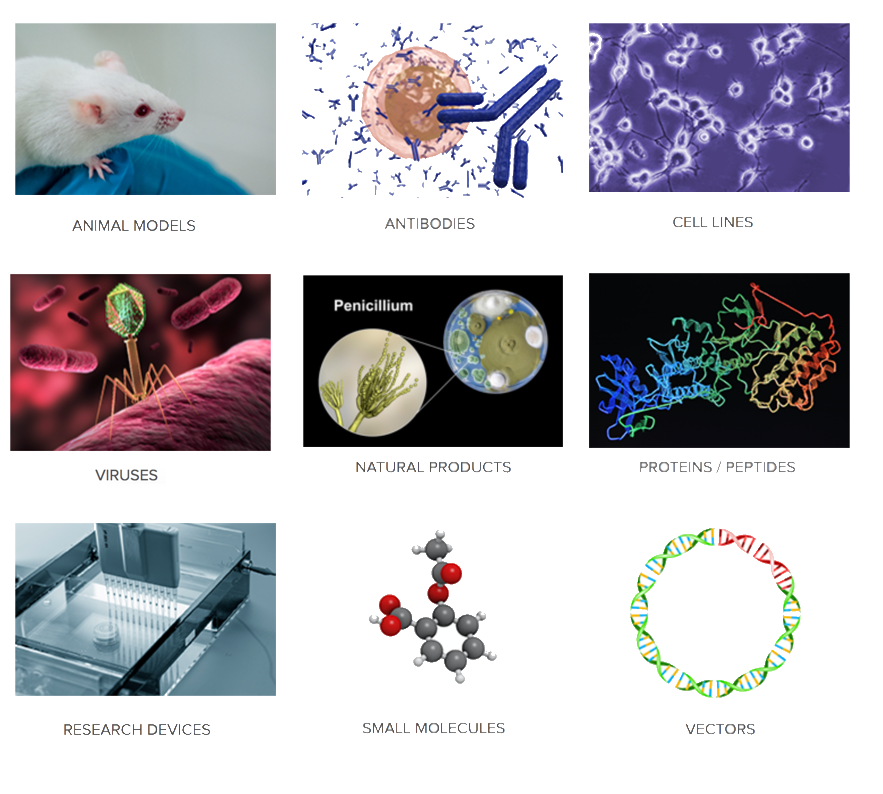
Common examples of research resources or research materials include:
- Antibodies, peptides and engineered proteins
- Small molecules, antisense oligonucleotides
- Research reagents
- Expression plasmids and proteins derived from them
- Cell surface receptors
- Cell lines
- Animal models (e.g., knockout mice)
- Research devices
Other research resources or materials include biological or other materials that are:
- Primarily useful for research purposes, such as in data related to the elucidation of disease mechanisms or to drug discovery
- Finished products that often do not require further development time and development costs in order to be utilized
- Broadly enabling inventions, useful in developing multiple products in numerous disciplines, rather than a single project-specific or product-specific use
What are a project team’s obligations with research tools?
Principal investigators and institutions that receive federal research funding are expected to disseminate research resources (research tools) broadly and in a timely manner. Failure to share these research tools can lead to unnecessarily redundant research and delays in scientific innovation.
U-M guidelines for compliance
Under Innovation Partnerships’ policy and the terms of most funding agreements, researchers have an obligation to promptly disclose to Innovation Partnerships any research tools capable of being used by others, whether a patent is being sought or not. A Biological Material/Research Tool Report is required for all research tool inventions and developments. These may accelerate someone else’s research, therefore, promote scientific innovation.
The Biological Material/Research Tool Report is a written description of the invention or development provided to Innovation Partnerships. The report refers to all sources of support and includes information necessary to begin pursuing dissemination and commercialization activities.
U-M Researchers can submit and share their research tools via Innovation Partnerships’ online innovation disclosure form. Innovation Partnerships works with investigators to add disclosed resources to a Research Tool Portfolio and recommends dissemination strategies. Depending on what dissemination strategy is chosen, either licensing revenue or production cost (material fee) may be reimbursed to the laboratory. For questions, email Innovation Partnerships at [email protected].
Sharing of the research tool does not have to wait until publication of research results; however, if possible, researchers should provide a supporting reference demonstrating the production and validation of the research tool. This delivers value to scientists who wish to use the tool in their own experiments by providing a method for experimental reproducibility.
Ease of sharing
Innovation Partnerships has relationships with third-party partners who can assist U-M researchers in maintaining and providing research tools to parties requesting access. This eliminates the burden on researchers of having to produce and ship research tools every time a request is made. Therefore, by disclosing a research tool to Innovation Partnerships, researchers can offload having to respond to future requests while better enabling the research community to access their tools.
Value of research tool sharing
Compliance
Bring more research funding opportunities
Faculty-Innovation Partnerships engagement
Uncover valuable inventions and guide to reach full potential
Reimburse production cost
Help maintain and reproduce the unique research tools to be ready to share when needed
Return to the public
Easily accessible to the global scientific community and accelerate scientific discoveries