
You are here
Getting Started
It can be overwhelming to learn about sponsored research, who to consult, and how to comply with U-M sponsor requirements when applying for a grant for sponsored funding or managing your award. Here's what you need to know to get started and to stay informed.
Tips for the U-M Research Administration Community
Here are a few tips to get your new RAs started and connected in U-M research administration.
- Sign up to receive The RAP/RAPid newsletters. (Be sure to check the boxes for RAN, Navigate, and eRPM updates.)
- Find RAN dates or register for RAN here: https://orsp.umich.edu/
ran (Note that registration is not yet open for the May meeting, but we will announce it in the above newsletter). - Join the RA Forum on Slack.
- Review and download: Best Practices for Communications with U-M Central Offices and Project Teams using eRPM.
- Visit the ORSP website which has content and resources not just for ORSP, but for general information for research administrators and faculty at U-M (newsletter links, current updates, access to Navigate training resources, a glimpse into the research lifecycle).
Helpful Hints for Faculty Working With ORSP
- In early discussions with sponsors, defer discussions of indirect cost arrangements to ORSP.
- Utilize ORSP for negotiation and review of agreements and grants.
- Leverage our signing authority services and grant acceptance on behalf of the University.
- Sign up for The RAP and its related newsletters for need-to-know sponsored research updates and resources.
- ORSP reviews and submits all proposals seeking external funding. For the most comprehensive review and submission, adhere to our Deadline Policy.
Where to begin when submitting a proposal or working with ORSP?
Your work may not start with us. While the Office of Research and Sponsored Projects (ORSP) is a unit of the Office of the Vice President for Research (OVPR), and ORSP is a key part of the research lifecycle, you should start working with the Research Administrator (RA) of your school/college/department/unit.
- When finding funding or developing a proposal, those early questions may begin in the school/college/department/unit, or even with the U-M library resources for finding funding opportunities.
- Leverage your unit's knowledge. Even before working with ORSP, you should start by working with the research administrator (RA) within your school/college/institute/department/unit who can help with policies, processes, systems, and forms. If you do not know who that person is you can use our Blue Pages to look up your research administrator to get a name and contact information.
- For more details on who does what, you can reference this entire website or these Roles and Responsibilities resources. Each of these PDFs also appears on the correlating lifecycle landing pages.
- Know that if you route a proposal, you will need to access U-M's eResearch, managed by ITS. You wiill use eResearch to communicate with ORSP and compliance offices. This website features some helpful ITS eResearch job aids that relate to routing a proposal or managing an award.
- Ultimately, you may work with a project representative (PR) from ORSP, but not until you submit. Your designated PR is also based on your school/college/department/unit, so be sure to have that information when contacting us. You can look up your ORSP PR here.
- Research project work may touch on one or more of research compliance areas found at research-compliance.umich.edu such as research integrity, human subjects, animal care, or more.
- Financial "post-award" aspects are handled by Finance-Sponsored Programs. Our partners at Sponsored Programs have a similar name to ORSP, but we are not the same. ORSP rolls up to the Office of the Vice President for Research. Sponsored Programs rolls up to the Office of Finance.
Understanding pre-award and post-award
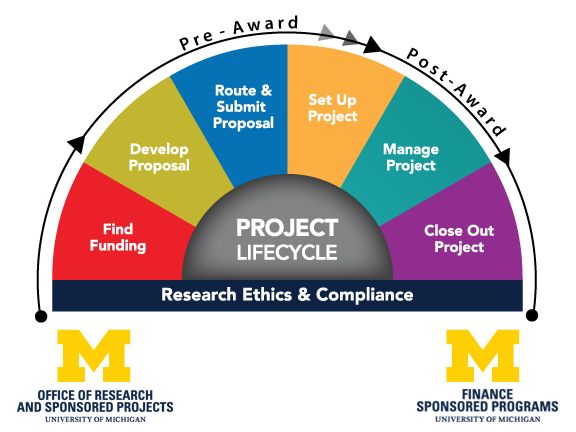
The Office of Research and Sponsored Projects (ORSP) primarily handles pre-award activities but also has roles throughout the life of a project. ORSP is a unit of the U-M Office of Research (OVPR).
ORSP project representatives review proposals and awards, negotiate agreements. ORSP processes all awards to Sponsored Programs (a unit of Finance) who partner with us to handle the financial aspects of post-award activities.
While Finance-Sponsored Programs handles post-award financial activities, ORSP continues to support project teams during post-award and throughout the remainder of the project lifecycle, working with the U-M project teams and various sponsors to meet research-related milestones, technical reporting, award changes, and closeout. ORSP helps (a) advocate for our research community in its pursuits, (b) protect U-M from financial and reputational harm, and (c) help our sponsors achieve their scientific and programmatic goals.
The Office of Research and Sponsored Projects (ORSP) primarily handles pre-award activities but also has roles throughout the life of a project. ORSP is a unit of the U-M Office of Research (OVPR).
Understand the difference between ORSP (Research) and Sponsored Programs (Finance)
Sponsored Programs primarily handles the financial post-award activities and is a unit of Finance.
Sponsored Programs' customer service staff help with financial milestones. while Sponsored Programs manages the financial post-award activities of the University of Michigan's research enterprise and other sponsored activities to ensure compliance with applicable federal, state, and local laws as well as sponsor regulations.
Understand the Research Project Lifecycle
The entire research project lifecycle rests upon a foundation of research ethics and compliance supporting the research project from concept to completion.
Our processes and our website are organized according to the lifecycle of a research project to enable understanding of sponsored projects from the beginning phases (pre-award) to the award start and completion phases (post-award). Research projects are complex with regard to both the science and the administration. A sponsored project’s lifecycle could extend for just a few months to decades.
What Does ORSP Handle and What Is a Sponsor?
The Office of Research and Sponsored Projects (ORSP) assists faculty and principal investigators (PIs) wishing to conduct research funded by an external sponsor, testing, or, to engage in research-related agreements with industry, non-profit, and governmental entities.
A sponsor is an entity that funds a project that might include research, training, or other sponsored research activity, which could be a grants, contracts or agreements, subcontract/sub-award, cooperative agreement, unfunded agreements (nondisclosures, memoranda of understanding), etc.
There are various types of sponsors, such as government (federal agencies, state agencies) or private (corporate or industry, or foundations and non-profit organizations).
Research grants from industrial and non-profit sponsors don’t always have the same flexibility as they do with federal sponsors, so ORSP’s Project Representatives help negotiate, facilitate and manage grants, agreements, and sponsored research relations. Be sure to consult our frequently required documents and data for proposals.
Learn about the characteristics of a sponsored project, how to distinguish it from a gift.
ORSP Response Times
Helpful customer practices
As ORSP’s partners in the U-M research enterprise, our customers often play a critical role in determining how responsive ORSP can actually be. To that end, ORSP recommends a number of helpful Project Team practices.
- Identify one individual who will serve as the single point of contact on all requests and inquiries.
- List the Principal Investigator’s name and explicitly reference the relevant PAF/AWD/UFA.
- Provide complete and accurate information or documents when submitting a request or inquiry.
- Ensure agreements to be negotiated are editable.
- Provide complete sponsor contact information.
- Adopting these practices will go a long way toward helping ORSP respond more quickly. Thanks for helping us help you!
What to do when you need something sooner
ORSP recognizes that our customers will occasionally need an urgent response. When an urgent matter arises, a member of the Project Team should call their ORSP officer to explain what’s going on and what the consequences will be if ORSP does not respond within the timeframe needed. The officer will do what he/she can to honor the Project Team’s request, but please know there is always the possibility that other work may already be in the officer's queue that is of an even higher priority or even more time sensitive. To find your ORSP contact, visit the ORSP Staff page.
FAQs
Funding searches are handled by the schools/colleges at the unit level. Grants and funding requests are not written and submitted independently. The federal government mandates that a central unit at universities administer research activities funded by sponsors.
These administrative tasks require a professional staff with broad knowledge of the regulations of federal agencies and to maintain the extensive records required by federal sponsors. Start by working with your Research Administrator.
The Office of Research and Sponsored Projects (ORSP) primarily handles pre-award activities and is part of the Office of Research.
Sponsored Programs primarily handles financial post-award activities, and is part of Finance.
References and Resources
- Navigate Overview of the Research Project Lifecycle
-
ORSP - Useful Web Resources
Useful Web Resources for Research Administrators - Annotated by ORSP Communications. Organized by the Research Project Lifecycle.
- Frequently Required Proposal Documents and Data